
HOUY Sivly
Research Assistant
Houy Sivly is a Research Assistant at the Centre for Development Economics and Trade (CDET). She holds a BA in International Relations from Paragon International University. Prior to joining CDRI, she used to intern in various institutions such as UNDP Cambodia, Asian Vision Institute, Cambodian Education Forum and Ministry of Foreign Affairs and International Cooperation.

Digital platforms are reshaping how firms access markets, manage transactions and participate in international trade. In Cambodia, where micro and small enterprises dominate, digital platforms offer opportunities to improve productivity, expand market reach and enable cross-border trade. Using firm-level data, this study examines the relationship b...
Gender gaps in digital adoption are mainly linked to structural factors affecting business scale rather than gender-specific technology barriers. When firm size is comparable, men and women owners show similar rates of digital adoption.Barriers to digital adoption for MSMEs include limited information, skill shortages, uncertain economic benefits,...
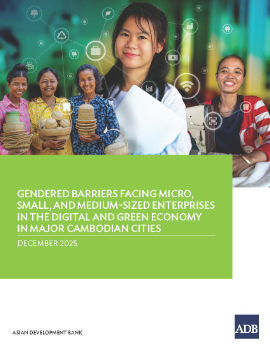
Drawing on extensive data and stakeholder insights, it reveals how unequal access to knowledge, finance, and networks can hold back enterprises owned by women. The report sets out targeted policy recommendations for inclusive economic development where women entrepreneurs are empowered to lead in the digital and green economy.For the full report, p...
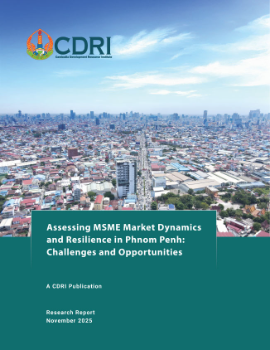
This report examines the market dynamics and resilience of micro, small, and medium enterprises (MSMEs) in Khan Meanchey, Phnom Penh, based on data from 14,820 establishments. MSMEs are deeply embedded in the urban economy, with nearly every household engaged in business activity. Despite a strong post-pandemic recovery in 2023, early signs of...
In a geoeconomic fragmentation, Cambodia’s financial sector faces the urgent challenge of enhancing inclusion while safeguarding stability. The transition of microfinance institutions (MFIs) into banks marks a potential pivotal step toward resilience, offering opportunities to expand financial inclusion and absorb external shocks. This study an...

Co-residence with parents may decrease domestic or childcare responsibilities for women when their parents share household duties; however, the reverse may happen as parents age, leading to increased domestic responsibilities when older parents require more care. In our study, using the General Population Census of Cambodia 2019, we investigate how...
This nationwide survey, conducted by the Cambodia Development Resource Institute (CDRI) in partnership with the Ministry of Labour and Vocational Training (MLVT), assesses current and emerging skills demand across provinces and municipalities in Cambodia. The study supports the recalibration of the TVET 1.5M Programme by identifying priority sk...
This project, jointly developed by CDRI and the Economic Research Institute for ASEAN and East Asia (ERIA), provides a comprehensive policy and programme framework to support the reintegration of approximately 910,000 Cambodian migrant workers who returned from Thailand in 2025. The initiative outlines a coordinated response that combines emerg...

Micro, small, and medium enterprises (MSMEs) form the backbone of Phnom Penh’s urban economy, yet they are increasingly pressured by economic slowdown, and digital disruption. High business turnover reflects survival-driven entrepreneurship, with most firms remaining informal, micro-scale, and concentrated in low-productivity sectors. Given the...

The CDRI Economic Updates provide regular updates on the state of the economy, specifically by tracking the economic cycle of wealth in Cambodia at both the macroeconomic and micro-household and business levels. It provides a brief summary of economic trends and their implications for each quarter, explaining the potential drivers of the curre...

CDRI has been conducting the Moving out of Poverty (MOP) survey since 1996/1997 in 3 village household samples and this sample have been extended 11 villages across 7 provinces by 2020. CDRI surveys the same 1000 households every three years to track the poverty dynamics across the five main regions of Cambodia. This rare longitudinal dataset i...

Micro, small, and medium-sized enterprises (MSMEs) often face challenges in utilizing digital technologies despite the vital roles of these technologies in business development. In particular, female-led MSMEs are less likely to use digital technologies. Previous studies have identified several barriers to digital technology adoption such as poor i...
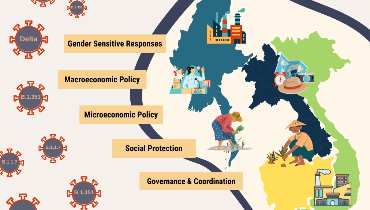
In close coordination with local governments and organizations, the project will identify gender-sensitive policies and good practices from the macro to micro level that will support the recovery process and improve resilience among vulnerable women workers and micro, small, and medium enterprises. It will facilitate policy dialogue and coordin...